

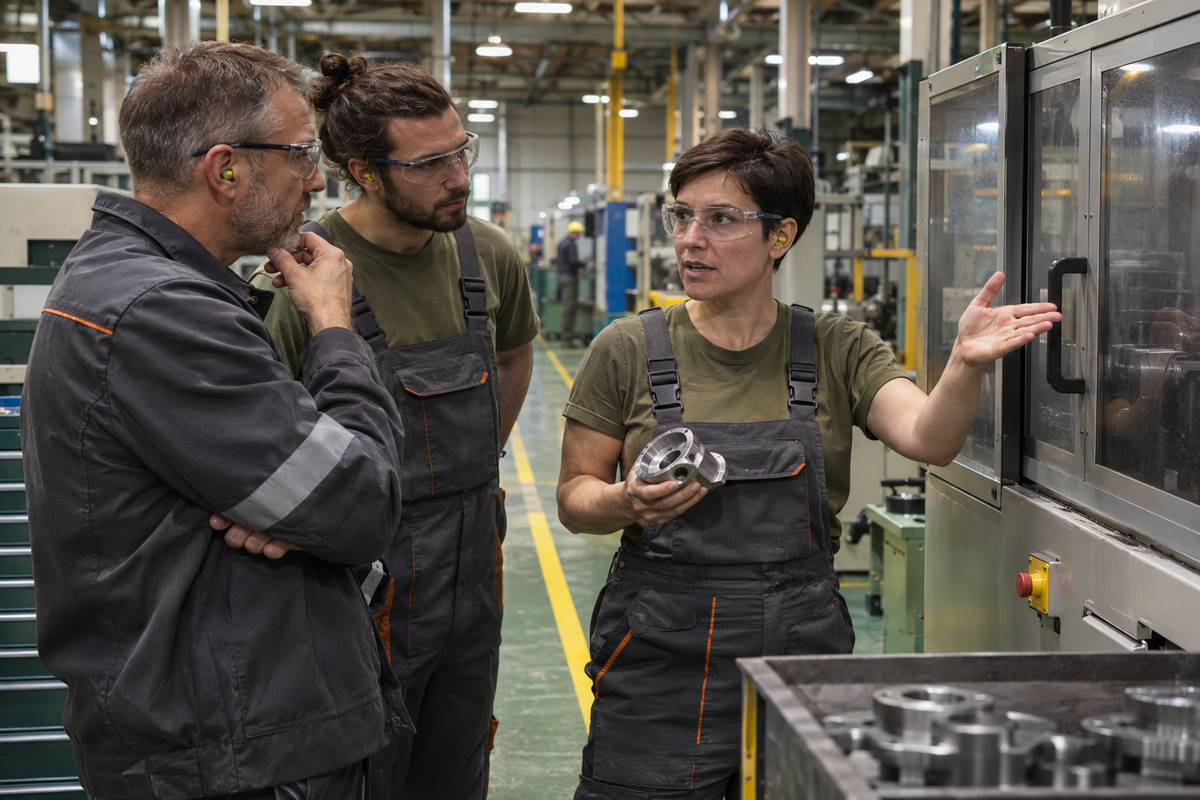
Cultural changes are often designed by leadership and then passed down to employees. Antoine Bisson’s article looks at the opposite direction: actively involving employees in changes intended to increase transparency and collaboration in manufacturing organizations.
Antoine Bisson links cultural change in manufacturing to two simultaneous challenges: experienced workers retiring and a new generation entering the workforce. If a company fails to capture the practical knowledge of departing experts, it loses procedures, exceptions and experience that are not contained in formal documentation. Digital transformation therefore should not be only a top-down deployment of a new tool, but a way to connect and empower people on the factory floor.
The article argues that even a small skills gap can have a measurable economic effect. Using a cited calculation, the author states that one hour of unproductive labor per week caused by skills gaps can amount to as much as $5,900 per employee annually. This is an argument for systematic knowledge capture and transfer, not a universal value for every plant.
A second weakness is accountability. In a traditional model, supervisors mainly track compliance while operators remain passive recipients of instructions. Bisson recommends moving more ownership of the process closer to the people who actually perform the work. If employees can document procedures, share experience and flag problems themselves, they become better able to resolve deviations without waiting for another management layer.
Digital connectivity is also intended to reduce operational silos. Information is often lost between shifts, teams or sites, while a good practice remains confined to one location. Continuous digital capture of work and procedures can create a shared knowledge base used by operators, supervisors and engineers across locations.
Bisson emphasizes access to real-time operational data. Digital dashboards can support frontline employees in decision-making and allow managers to see where processes are working and where teams need help. Citing Deloitte, the article reports an average 22 percent productivity increase when frontline workers use digital technology to support performance. This is a figure cited by the author, not a result from a specific plant described in the article.
Transparency also matters for younger employees, who according to the author expect information at work to be as accessible as it is in their personal lives. Paper-based procedures, limited access to training and outdated systems can increase frustration and reduce engagement, especially when a new hire cannot easily find a current instruction.
Cultural change is not limited to operators. If plant managers and senior executives have more direct visibility into training progress, operating problems and improvement ideas, they can respond earlier to deviations and connect corporate strategy more closely with factory-floor reality.
The article’s conclusion is less technological than the topic of digital manufacturing might suggest. Culture does not change because a company buys a new device. It changes when connectivity among people and information shifts the organization from simple compliance toward greater ownership, knowledge sharing and active improvement.
KEY TERMS
- Corporate culture: The set of real norms and behaviors that shape the organization’s everyday operation.
- Participatory change: Change in which the people affected are actively involved in its design and implementation.
- Manufacturing management: Management of people, processes and resources in a production environment.
- Transparency: Clarity of decision-making, responsibilities and the handling of employee input.