

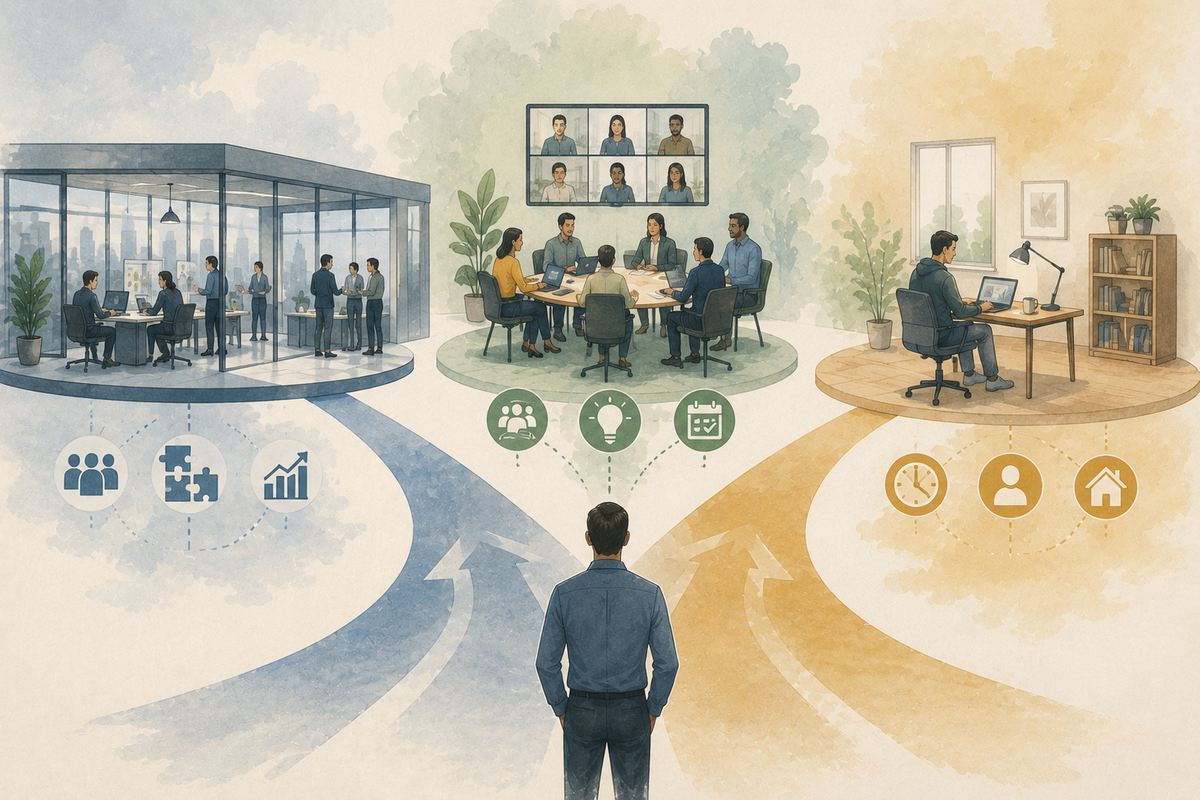
Business leaders have not converged on either full office attendance or fully remote work as the only correct model. In a survey of U.S. CEOs, hybrid arrangements dominate. The reasons are not purely HR-related: companies weigh access to a broader labor market, office costs, retention, collaboration, and the nature of individual roles.
After several years, the debate over where work should happen is gradually changing. Instead of asking whether the office or remote work is generally better, companies are increasingly looking for a model that matches their actual activities. An Inc. survey of CEOs shows hybrid work as the dominant arrangement, with results closely matching Gallup data on U.S. employees whose jobs can be done remotely. Gallup reports 52 percent of these employees working hybrid, 26 percent fully remote, and 22 percent entirely on-site. In the Inc. survey, the company split was 51–26–23.
The important point is that the same arrangement can serve different purposes in different companies. Businesses supporting remote work cite access to a broader pool of candidates, lower office costs, employee retention, and work-life balance. One company in the survey employs people across five countries and thirteen U.S. states and sees remote work as a condition for further growth. Another uses flexibility as a recruiting advantage against competitors that require regular office attendance.
A hybrid model also makes it possible to tailor working arrangements to the nature of the job. One respondent, for example, described fully on-site field teams combined with hybrid arrangements for headquarters staff. This is more practical than a single company-wide rule when roles differ substantially in their need for physical presence.
Hybrid work is not automatically a cost-free compromise. A company needs to know why employees should come to the workplace in a given situation. If an employee travels to the office only to spend the entire day on video calls with remote colleagues, physical presence itself adds little value. Meaningful in-person days should be linked to activities that genuinely benefit from direct contact: complex collaboration, conflict resolution, creating a new solution, onboarding, or relationship building.
Management practices also need to change. The performance of a remote employee cannot be judged reliably by visibility in the workplace. Managers need clear outcomes, deadlines, availability rules, and regular conversations. They must also watch whether remote employees lose access to information or opportunities simply because they are not physically present.
The central question for a company is therefore not how many days people should spend in the office. It is more useful to determine which activities require a shared location, which can be performed effectively remotely, and by which outcomes work will be evaluated.